What Is the Difference Between a CDD and an HOA in St. Johns County?

Buying in Nocatee, RiverTown, or Shearwater? Here Is What a CDD and HOA Actually Mean for Your Monthly Costs
In St. Johns County, many master-planned communities have both a CDD (Community Development District) and an HOA (Homeowners Association). They are not the same thing -- a CDD is a government taxing district that funds infrastructure, while an HOA is a private organization that sets community rules and maintains shared amenities. Understanding both before you make an offer can save you from sticker shock at closing and every year after.
Why This Question Comes Up So Often in Northeast Florida
If you are shopping for a home in St. Johns County -- especially in communities like Nocatee, RiverTown, Shearwater, Tributary, or Silverleaf -- you have probably seen two separate line items in the listing details that look a lot alike: a CDD fee and an HOA fee. Many buyers assume they are the same thing, or that one cancels the other out. They do not.
This confusion is completely understandable. These two structures exist in the same community, they both cost you money, and the distinction is not something most people learn until their agent explains it -- or until they see their first property tax bill. Let me break down exactly what each one is, what it covers, who controls it, and how the two work together in places like Nocatee and RiverTown.
What Is a CDD (Community Development District)?
A Community Development District is a special-purpose local government created under Florida law (Chapter 190, Florida Statutes). Developers use CDDs as a financing mechanism to build the infrastructure that makes large master-planned communities possible -- roads, water and sewer systems, drainage, parks, amenity centers, pools, and more. The developer essentially bonds the cost of that infrastructure and repays it through assessments on homeowners over time.
Here is the key point that surprises most buyers: a CDD is a government entity. It has the power to levy taxes and assessments. That means your CDD fees show up on your annual property tax bill -- not in a separate invoice from a private company. You pay them along with your county taxes every November.
CDD fees in St. Johns County communities typically have two components:
- Debt service assessment -- this pays off the bonds used to build the original infrastructure. It has a fixed repayment schedule, usually 20 to 30 years, and goes away when the bonds are retired.
- Operations and maintenance (O&M) assessment -- this covers the ongoing cost of maintaining the infrastructure the CDD built. It does not go away; it continues as long as you own the home.
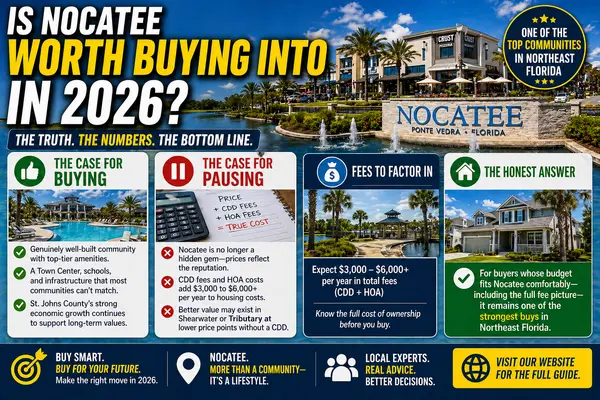
CDD fees vary significantly by community and by lot. In Nocatee, for example, CDD fees on a single-family home can range from roughly $1,500 to over $3,000 per year depending on the village and lot size. Some newer sections of RiverTown and Tributary carry similar or higher amounts. Always ask for the exact CDD line item on the tax bill for the specific property you are considering -- not a range, not an estimate.
What Is an HOA (Homeowners Association)?
A Homeowners Association is a private, non-governmental organization made up of the property owners within a community. The HOA is governed by a board of directors elected from among homeowners, and it operates under a set of governing documents -- a Declaration of Covenants, Conditions, and Restrictions (CC&Rs), bylaws, and rules and regulations.
The HOA collects dues from homeowners and uses them to maintain common areas, enforce community standards, manage amenities, and fund reserves for future repairs. Unlike a CDD fee, HOA dues are collected directly by the association -- not through your property tax bill. You will typically receive a separate invoice, and many associations allow monthly, quarterly, or annual payment.
In master-planned communities across St. Johns County, HOA fees often cover:
- Landscaping and maintenance of common areas, medians, and entryways
- Access to resort-style amenities -- pools, fitness centers, walking trails, playgrounds
- Community events and programming
- Architectural review to maintain the look and feel of the neighborhood
- Reserves for future repairs or replacements
HOA fees in St. Johns County communities range widely. Some communities charge as little as $100 to $150 per month; others with more extensive amenities can run $200 to $400 per month or more. Within a single master-planned community like Nocatee, there is often a master HOA fee that covers the overarching community and a sub-association fee for the specific village or neighborhood within it.
Not Sure What You Are Really Paying in a Community That Interests You?
Joey Larsen specializes in master-planned communities across St. Johns and Nassau Counties. He can pull the full fee picture -- CDD, HOA, sub-HOA -- for any property you are considering before you write an offer.
Call or text Joey Larsen: 904-863-6679
or visit RetireMeToFlorida.com
How a CDD and an HOA Exist in the Same Community
In a large master-planned community, both structures typically exist at the same time -- and they serve different functions. Think of it this way: the CDD built the bones of the community and continues to maintain the infrastructure. The HOA maintains the aesthetics and the amenity experience and enforces the community rules.
In Nocatee, for example, the Nocatee Community Development District handles infrastructure like the road network, drainage systems, and certain community-wide amenities. Each village within Nocatee also has its own HOA (or sub-HOA) that manages the specific neighborhood's common areas and enforces the CC&Rs for that section. Some villages also belong to the master Nocatee HOA, adding a third layer.
As a buyer, this means you could be looking at:
- A CDD assessment on your tax bill (debt service + O&M)
- A master community HOA fee
- A village or sub-association HOA fee
All three of these are legitimate, legal, and disclosed -- but only if you know to ask about all of them. Your agent and the seller's disclosure documents should surface all of these, but it is worth double-checking every line before you finalize your budget.
Who Controls Each One -- and Who Do You Call When Something Goes Wrong?
This is one of the most practical differences between a CDD and an HOA. They are governed separately and have entirely different chains of accountability.
A CDD is run by a board of supervisors. Initially, those supervisors are appointed by the developer. As homes are sold and homeowners accumulate, control transitions to elected residents. CDD board meetings are public, recorded, and subject to Florida Sunshine Laws -- meaning the financial records and meeting minutes are public documents you can request at any time.
An HOA is governed by a board of directors elected from among homeowners. HOA governance is subject to the Florida Homeowners' Association Act (Chapter 720, Florida Statutes), which gives homeowners certain rights around access to records, notice of meetings, and dispute resolution. If your HOA is not following its own rules, you have legal recourse -- but it is a private matter, not a government one.
If a road inside your community needs repair, that may be a CDD issue. If a neighbor painted their house the wrong color, that is an HOA matter. If the community pool is not being maintained, it depends on who owns it -- the CDD or the HOA -- which varies by community.
"We almost made an offer on a house in Nocatee without realizing there were three separate fees on top of the base mortgage payment. Joey walked us through the full CDD and HOA breakdown before we toured anything, so we knew exactly what we were comparing. It made budgeting so much easier and we never felt blindsided."
-- Buyers relocating from Virginia, purchased in Nocatee, 2025Can CDD Fees Be Paid Off Early?
Yes -- and this is a question worth asking when you are comparing properties. The debt service portion of a CDD assessment can sometimes be paid off at closing as a lump sum. This eliminates that portion of your annual tax bill going forward, though you will still owe the O&M assessment as long as you own the home.
Whether it makes sense to pay off the CDD debt at closing depends on the remaining balance, your loan terms, and how long you plan to stay in the home. Some sellers pay it off before listing to make their home more attractive; others price it into the home and leave it for the buyer. Your agent can help you evaluate what makes more financial sense in a specific transaction.
What To Look for in the Listing Details
When you are reviewing a listing in St. Johns County, here is what to look for and verify before making an offer:
- HOA fee amount and frequency -- monthly, quarterly, or annual? Is there a master HOA and a sub-HOA?
- CDD fee amount -- this is listed separately from HOA in most MLS entries and shows up on the tax bill. Get the actual tax bill from the prior year, not just the estimate.
- What each fee covers -- request the HOA's amenity list and the CDD's operations summary so you know what you are paying for
- HOA reserve fund health -- a healthy reserve means less risk of a special assessment down the road
- Pending CDD projects or special assessments -- ask if any new bond issuances or infrastructure projects are in process
Frequently Asked Questions
Are CDD fees tax-deductible?
The O&M portion of a CDD assessment may be deductible as a real estate tax, since it is levied by a government entity. The debt service portion is generally not deductible. You should consult a tax professional for advice specific to your situation, as tax treatment can vary.
Do CDD fees go away over time?
The debt service portion of the CDD assessment does go away once the infrastructure bonds are paid off -- typically over 20 to 30 years. The O&M portion does not go away; it continues indefinitely to fund ongoing maintenance of the infrastructure the CDD owns.
What happens if I do not pay my HOA dues?
Under Florida law, an HOA can place a lien on your property for unpaid dues and, in some circumstances, pursue foreclosure. HOA dues are a legal obligation of homeownership in communities with mandatory associations -- they are not optional fees you can decline.
Can an HOA restrict how I use my property?
Yes. HOAs enforce architectural and use restrictions contained in the community's CC&Rs. These can cover everything from exterior paint colors and fence types to parking rules and short-term rental restrictions. Before you close, read the CC&Rs for any community you are seriously considering -- your agent can help you get them.
Is it possible to buy in St. Johns County without a CDD?
Yes, though many of the newer master-planned communities in the county do carry CDDs. Older neighborhoods, smaller subdivisions, and resale communities outside the major planned developments may have only an HOA or no association at all. Talk with your agent about which communities match your preferences and budget.
Search Northeast Florida Homes
Browse active listings in Nocatee, RiverTown, Tributary, Shearwater, Silverleaf, and communities across St. Johns and Nassau Counties.
What To Do Right Now
If you are considering a home in Nocatee, RiverTown, Shearwater, or any other master-planned community in Northeast Florida, get the full fee picture before you fall in love with a floor plan. Knowing all three layers -- CDD, master HOA, and sub-HOA -- is the difference between a budget that works and one that surprises you every November.
Call or text Joey Larsen at 904-863-6679, or visit RetireMeToFlorida.com to get started.
Categories
- All Blogs (37)
- Buyer Questions (10)
- Buyer Resources (14)
- Communities (3)
- Cost of Living (6)
- Insurance & Risk (1)
- Jacksonville / St. Johns County (3)
- Local Area Happenings (1)
- Market Update (3)
- Nocatee (2)
- Northeast Florida Market (1)
- Our Communities (2)
- Questions Buyer Are Asking (4)
- Questions Sellers Are Asking (1)
- Real Estate Done Right (5)
- Relocation (1)
- Retirement Planning (4)
- Seller Resources (3)
Recent Posts